

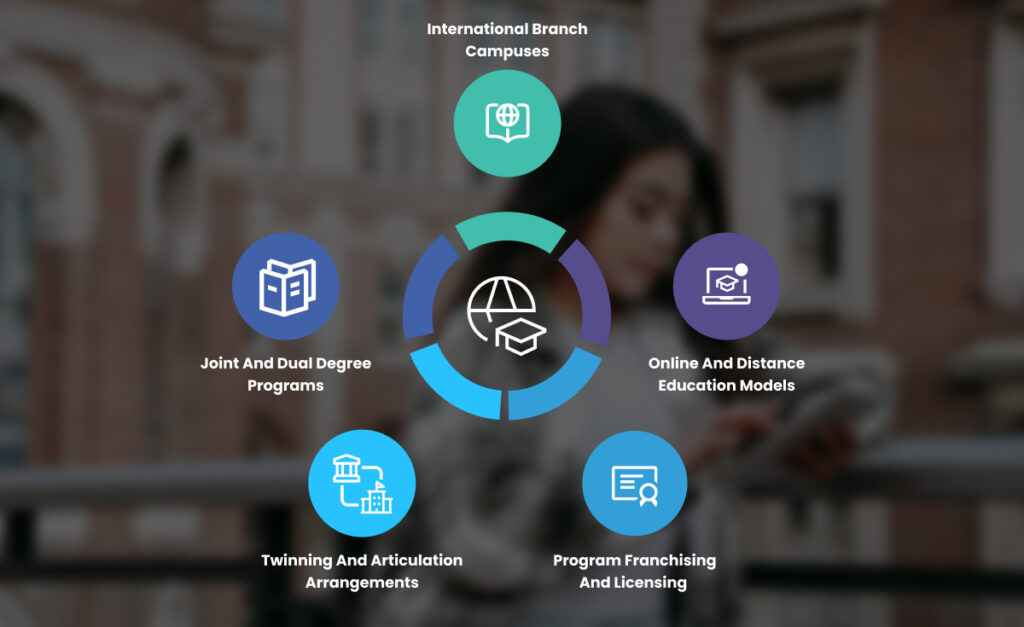
Transnational education has become one of the ways for Australian universities to be effective in the field of international education; these models provide universities with the opportunity to enter new markets, diversify their revenue sources, and strengthen their international brand power. According to experts’ statements, offshore education providers will continue to grow in an increasingly globalized world and will become more important for Australian providers in terms of taking advantage of market opportunities.
International Branch Campuses
International branch campuses involve an Australian university establishing a physical campus in a foreign country and offering its programs to local students there. These campuses may be fully owned by the Australian home institution or jointly operated. Branch campuses generally reflect the home campus’s academic standards, rules, and facilities; they provide face-to-face teaching and a campus experience similar to that of the main campus in Australia. For example, an Australian university may open a campus in another country and deliver its entire curriculum locally, allowing students to earn the same degree without leaving their home country.
This model adds value for the university in terms of prestige and brand management in the host country; however, it requires significant investment and operational workload. Branch campuses were among the earliest Transnational education initiatives in the 1990s, but over the long term they have proven complex and costly to sustain. Over the years, some Australian International branch campuses have closed due to financial and logistical challenges. As a result, today branch campuses represent a smaller (yet still important) part of Australia’s TNE portfolio; to ensure sustainability, they often focus on specific programs or strategic partnerships.
Joint and Dual Degree Programs
In joint and dual degree programs, an Australian university works with an overseas partner to design and deliver a degree together. Students usually divide their studies between the two campuses. For example, they might spend part of the program at the partner university in their home country and the rest in Australia, or the other way around. When they finish, graduates receive a qualification from both institutions, either as a single degree awarded by both or as two separate degrees, one from each university. These programs require both universities to match their curricula and academic standards, and they often need approval from education authorities in both countries.
Joint or dual degrees give students a rich international experience, letting them learn in different cultures, languages, and teaching styles. Australian universities have set up many of these programs around the world. For instance, there are several Australian-Chinese joint degree programs and institutes that let students in China earn both an Australian and a Chinese degree. This approach helps the qualification gain global recognition and can build stronger ties between institutions. However, it also means universities must carefully coordinate admissions, credit transfers, and quality assurance.
Twinning and Articulation Arrangements
Twinning and articulation arrangements create a structured pathway for students to begin a degree program in their home country and finish it in Australia. In a typical twinning arrangement (often called a “2+2” or “3+1” program), students complete the first one or two years of an Australian degree at a local partner institution, then transfer to the Australian university to complete the remaining years on the home campus. If the student meets the academic requirements, they are awarded the Australian university’s degree after finishing the final components in Australia. Articulation agreements are closely related, they formally recognize the coursework at a partner institution as equivalent to a certain portion of the Australian program, granting students advanced standing (entry into year 2 or 3) upon transfer.
For example, an Australian university might have an articulation agreement with a college overseas such that graduates of the college’s two-year diploma can directly enter the Australian bachelor’s program in third year. These twinning models are popular at the undergraduate level. They allow students to save on cost-of-living and tuition by undertaking part of their studies locally, and to acclimate before moving abroad. Australian universities maintain close academic coordination with twinning partners to ensure the curriculum and teaching meet required standards. Students know from the outset that by completing the specified portion at the local partner and meeting requirements, they can seamlessly continue their degree in Australia. This model has been widely used in countries like Malaysia, China, and others, and is a cornerstone of Australia’s TNE strategy to recruit international students through transfer pathways.
Program Franchising and Licensing
Franchising enables Australian institutions to expand their reach into international markets without bearing the cost of operating a full campus overseas. To protect quality, it is usually implemented through detailed agreements; the Australian university may moderate assessments or may approve the qualifications of the teaching staff, and this is one of the most critical details in this regard. This model is common in transnational education globally (especially among UK universities), and Australian providers have increasingly been exploring franchise partnerships in recent years.
For example, an Australian business degree may be licensed to a college in another country: students enroll at the local college, study by following the Australian curriculum, and receive the Australian university’s degree at the end of the program. Program franchising relies on trust and compliance because the Australian university’s reputation is directly at stake. When done well, it can rapidly increase overseas enrolments and make Australian qualifications accessible to more students. In this model, a separate degree is generally not awarded by the partner institution; unlike the joint degree model, the credential belongs to the Australian provider. Variants of this model include “validation” arrangements, in which the Australian university formally accredits a program delivered by the local institution. In all cases, while partnership-based delivery has now come to represent a significant share of Australia’s transnational education structure, branch campuses are comparatively fewer.
Online and Distance Education Models
Australian universities also offer programs to international students through online and distance education. In this approach, students complete Australian courses from their own countries using online platforms or other remote learning methods, without any face-to-face teaching in the host country. Thanks to digital education, students can earn an Australian degree by attending virtual classes, watching recorded lectures, and submitting assignments online. Australian universities widely use online course delivery to reach students around the world, offering a broad range of programs from short courses and micro-credentials to full degrees. Sometimes, these online TNE programs are designed for specific markets, such as an online MBA program for students in a particular region.
The biggest advantage of online TNE is the flexibility and wide access it provides: students in different countries can enroll in Australian programs at the same time without worrying about location. Since the pandemic, online transnational programs have grown as universities have invested in remote teaching tools. Although online TNE does not provide the “in-country” experience offered by other models, it is a cost-effective and practical way for Australian universities to deliver education to students overseas. Distance learners still earn an accredited Australian qualification, and universities provide support services such as virtual libraries, tutor support, and discussion forums to ensure a good student experience. This system helps Australian higher education reach students across many countries worldwide.