

Graduate employability in Australia doesn’t get lumped together into a single “careers office” function. Instead, it’s built into the student journey through course design, industry connections, pathways between Universities and VET, and national tracking systems to see how it’s all going. And recently, Australia’s tertiary education system has been shifting to make sure Universities are teaching the skills that are actually needed in the workforce.
Why Getting Graduates Hired is a Matter in Australia
Australia’s got a clear direction on this. Back in 2024, the Australian Universities Accord Final Report came out with a long term plan for Universities and included recommendations to make sure the system is teaching the right skills for the future. Also, Jobs and Skills Australia has been pushing the same direction with their Tertiary Harmonisation Roadmap, which is all about making sure Universities are accessible, effective and can respond to skills shortages and productivity challenges. These developments show that in Australia, employability is being seen as a system-wide thing, not just a marketing spin by individual Universities.
How Australian Universities Make Employability Part of the Student Journey
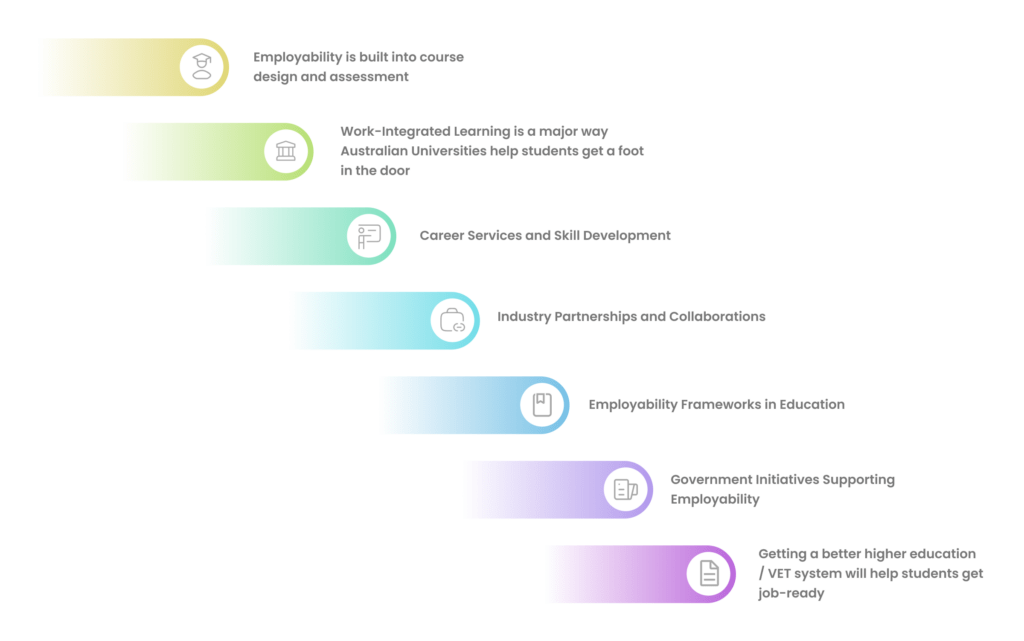
Employability is built into course design and assessment
In Australia, Universities are expected to show that their courses, what they teach, how they teach it and how they assess it, is on par with what’s expected for the qualification level and the subject. Also, TEQSA stresses that students should be able to achieve the same learning outcomes regardless of whether they’re on-campus or learning online. This is big for employability because it means Universities are supposed to design courses where students are actually learning, practicing and getting assessed on the skills they need to get a job, not just leaving it to be tacked on as an afterthought near the end of the course. TEQSA also says that Universities need to show where these skills are being taught and assessed, like capstones and industry standards where relevant.
Work-Integrated Learning is a major way Australian Universities help students get a foot in the door
Many Australian Universities use Work-Integrated Learning, as a way to give students real work experience before they graduate. The Department of Education’s guidance explicitly says that WIL is a way to improve employability, through internships, cadetships and work placements. These WIL activities usually happen in later years, giving students a chance to put theory into practice and improve workplace skills with professional guidance. Providers also offer global exchange or virtual internships to broaden experience.
- Internships and WIL programs: Structured internships, placements, practicums and cooperative projects are now common parts of degrees and certificates.
- Many institutions fund overseas internships and exchanges, often in related fields, so students can gain cross-cultural and global industry experience.
- Capstone projects and industry assignments bring real-world challenges from employers into courses, allowing students to work with companies for credit.
Career Services and Skill Development
Beyond formal placements, tertiary providers bolster employability through dedicated career and skills centres. Universities maintain Career Services that coach students on job readiness: they offer workshops on resume writing, interview techniques, networking and job search strategies. Students are encouraged to engage in extracurricular activities (clubs, leadership programs, hackathons) to practise teamwork and initiative. Career advisers also run mock interviews and career fairs. Many institutions have mentoring programs connecting students with alumni or professionals in their field, further developing workplace norms and networks.
- Tertiary courses often include training in communication, problem-solving, and digital literacy. Workshops, seminars, or micro-credentials focus on these transferable skills.
- Some universities offer formal “employability awards” or digital badges for completing career-related modules. These programs certify that graduates have shown skills in teamwork, project management, or leadership.
- Universities provide job portals, on-campus recruitment events, and links to graduate recruiters. Career hubs organize networking nights for specific sectors like engineering, law, and health, along with interview workshops to help students move into the workforce.
Industry Partnerships and Collaborations
A key strategy is forging strong links with employers. Universities and TAFEs co-design programs with industry to align training with workforce needs. Similarly, many universities have Industry Advisory Boards, panels of employers who regularly review course content. Some degrees (especially in engineering, IT, business and health) require mandatory internships arranged through the school, while others embed guest lectures and site visits by industry experts. Providers also cooperate on research and innovation projects that benefit students. Many career centres host employer events.
Courses are often tailored with input from industry. Advisory boards or formal partnerships help ensure students learn the skills and tools employers need.
Some companies partner with universities to offer cadetships, apprenticeships, or traineeships that combine study with paid work, especially in trades, IT, and healthcare.
Employers may sponsor labs or mentoring programs.
Employability Frameworks in Education
Many Australian institutions use national employability skill frameworks to teach workplace skills. These frameworks list broad skill categories graduates should have. For example, the well-known Employability Skills Framework identifies eight core skills: communication, teamwork, problem-solving, initiative, planning, self-management, learning, and technology. Although Australia does not have one official “National Employability Framework” for all sectors, institutions often follow related models. Some VET guidelines, like the Core Skills for Work Developmental Framework, also list skill clusters employers want. Using these frameworks helps education providers ensure students develop a balanced set of abilities.
Government Initiatives Supporting Employability
The Australian Government has introduced several initiatives to strengthen graduate readiness. The Job-Ready Graduates package, a higher-education reform that began in 2021, adjusted funding to encourage growth in STEM, education and healthcare fields. Its priorities explicitly include increasing internships, practicums and other work-integrated learning opportunities, raising the number of STEM-skilled graduates, and strengthening university and industry partnerships.
A major federal initiative for vocational education is the creation of TAFE Centres of Excellence. Under the National Skills Agreement, the government has invested millions to set up networked centres across states focused on key industries like advanced manufacturing, digital technology, and net-zero energy. They share best training practices nationwide, helping TAFEs stay responsive to employer needs.
Getting a better higher education / VET system will help students get job-ready
There’s a big trend in Australia where Universities and VET providers are working more closely together. Jobs and Skills Australia reckon that sorting out this “tertiary harmonisation” will actually help make the whole system work better, it’ll help make sure people can access the education they need and make it easier to get the skills that employers are actually needing. For graduate employability, that means more potential for clearer, and better, pathways between courses, stronger combinations of theory and actual hands-on training, things that line up faster with what industry and employers actually need, and that’s all good stuff. It’s especially important in areas where employers want to see some real world skills as well as just a university degree.