

The following article reflects insights and perspectives shared by policymakers, university leaders, and experts during the Financial Review Higher Education Summit 2025 in Australia. Explore key themes in admissions growth, AI adoption, transnational delivery, governance reform, and the road to 2050 — and how Meshed platforms can support institutions through these sector-wide changes.
Australia’s higher education sector is at a pivotal moment. With more students, fewer staff, and intensifying financial and governance pressures, the conversations among policymakers, university leaders, and industry experts are shaping the future of how education will be delivered and sustained.
At a recent national higher education forum, government officials, university vice-chancellors, and policy experts came together to discuss the opportunities and challenges that will define the sector over the next decade. Here are the key takeaways.
Growth, Productivity, and Funding
Minister for Education Jason Clare opened the day discussing how student enrolments have increased by 60%, while staff numbers have grown by only 40% over the past 20 years. He recognised it has also that this has also strained resources in Higher Education providers.
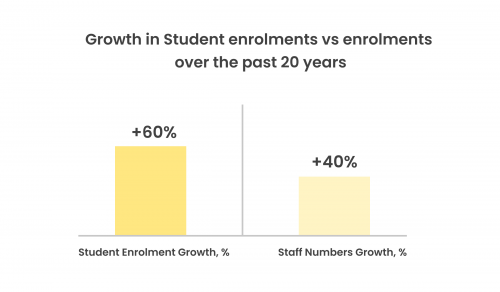
Figure 1: Growth trends in student enrolments and staff numbers across a 20-year period.
He also noted the contribution that Highly educated citizens make to both national and global productivity
The government has committed $6.7 billion over the next decade to ensure growth is managed sustainably. A stronger focus will be placed on affordability for Indigenous students and those from lower-income families, as well as governance reforms through the creation of student ombudsmen and expert councils.
At the same time, a review of TEQSA’s powers is set to begin within weeks, signalling an evolving compliance and regulatory environment for higher education providers.
The Role of AI in Higher Education
Artificial intelligence dominated discussions, with a recurring theme that AI will augment rather than replace jobs. Universities are embedding AI into their operations and teaching, and they project that widespread adoption within each institution will occur within the next 2–5 years.
Monash University has already partnered strategically with Microsoft to deploy AI-powered copilots, while La Trobe University shared insights on AI’s role in business operations and research efficiency. However, as Vice-Chancellor David Lloyd (University of South Australia) emphasised, AI adoption must be trust-led and transparent.
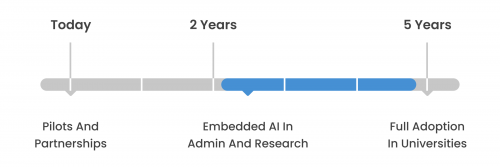
Figure 2: AI adoption in universities, from pilots to widespread
International Students and Transnational Education
International students remain a cornerstone of Australia’s education sector — both economically and diplomatically. While the government has signalled an unpopular enrolment “cap,” Jason Clare clarified that this is not a hard limit, but part of a managed growth strategy.
The sector is also turning toward transnational education, with universities exploring offshore campuses and partnerships, particularly in India and Southeast Asia. This global expansion is seen as a way to balance domestic priorities while strengthening Australia’s international education footprint.
However, challenges remain: English language colleges are struggling under increased visa fees, and contradictions exist in government messaging on migration policy. Experts argue that better pathways are needed for skilled migration, alongside reforms to ATARs and student visa frameworks.
Sector Fragility and Governance
Multiple panels addressed the financial and structural fragility facing universities. With higher education expenditure dropping from 0.9% of GDP to 0.6%, many institutions are competing for limited funds — described by several speakers as a “Hunger Games” scenario.
Governance also remains a hot topic. While some high-profile failures have drawn attention, panellists emphasised that the overall system is not broken, though greater transparency and accountability are needed.
Questions of VC remuneration (up to $1M annually) also sparked debate, as did the balance of administrators versus academic staff within increasingly large and complex universities.

Figure 3: Universities facing a “Hunger Games” scenario due to
financial fragility and competition for limited resources in higher education.
The Student Experience
Student complaints remain consistent across institutions:
- 46% related to fees and refunds
- 27% to course administration
- 17% to appeals and misconduct
Speakers stressed the importance of improving back-of-house systems to address these issues before they escalate to the Ombudsman. With AI misuse also emerging as a problem, universities must adapt their academic integrity processes to the realities of new technologies.
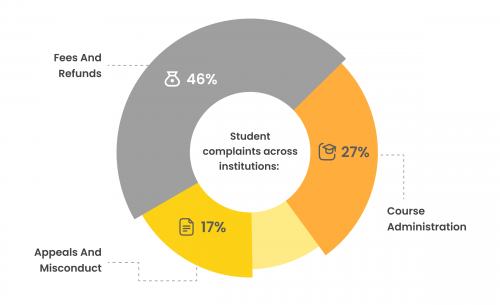
Figure 4: Distribution of Student Complaints Across Institutions
Looking Ahead
The message from policymakers, educators, and experts is clear: Australia has not reached “peak university.” With projections of additional students in the next decade, the sector must continue to adapt through innovation, governance reform, and managed growth.
As Jason Clare highlighted, the goal is for 4 out of 5 Australians to hold a tertiary or higher qualification by 2050. Achieving this will require not just funding and reform, but also bold collaboration across higher education, vocational training, government, and industry.
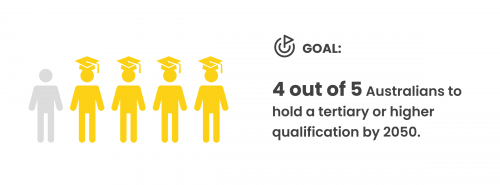
Figure 5: By 2050, 4 in 5 Australians projected to hold a tertiary qualification
At Meshed, we believe technology plays a vital role in enabling this future — helping institutions streamline compliance, enhance student experience, and embrace innovation with confidence.
Want to explore how Meshed platforms can support your institution through these changes? Contact us to start the conversation.